
Sensitive Host Cell Protein Identification in Biotherapeutics Using Advanced LC-MS/MS Analysis
news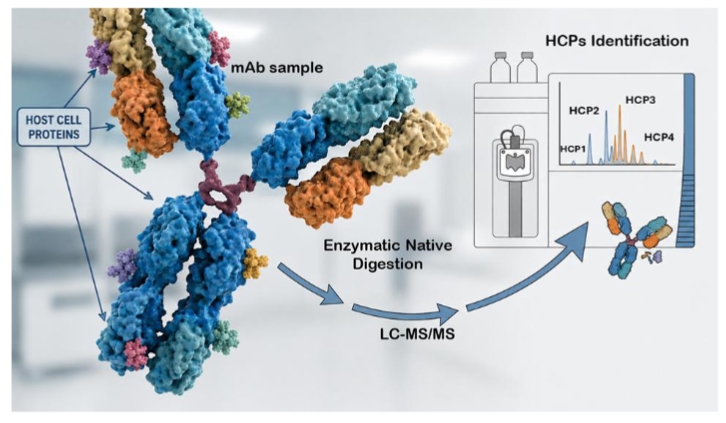
Biotherapeutic products manufactured in recombinant expression systems may retain trace amounts of proteins originating from the production of host cells. Even at low concentrations, these host cell proteins (HCPs) can influence product quality by affecting stability, reducing therapeutic performance, or triggering unwanted immune responses. Chinese hamster ovary (CHO) cells are the most common cell lines used for therapeutic drug production. As the biopharmaceutical industry continues to expand, the global demand for monoclonal antibodies (mAbs) and recombinant proteins is increasing.
Conventional immunoassays such as ELISA are commonly used to estimate total HCP content; however, they do not provide information about the identity, abundance, or potential risk associated with specific HCP species that could be critical quality attributes (CQAs)4. Advanced LC-MS/MS–based workflows offer a powerful orthogonal approach by enabling direct detection, characterization, and relative quantification of individual HCPs within complex biologic matrices. Despite these advantages, the identification of low-level HCPs remains analytically challenging due to the large dynamic range between highly abundant therapeutic proteins and trace-level residual impurities.